Article · Faith & Life
Remembering Bishop Emeritus Samuel Balagadde Ssekadde (1944–2024)

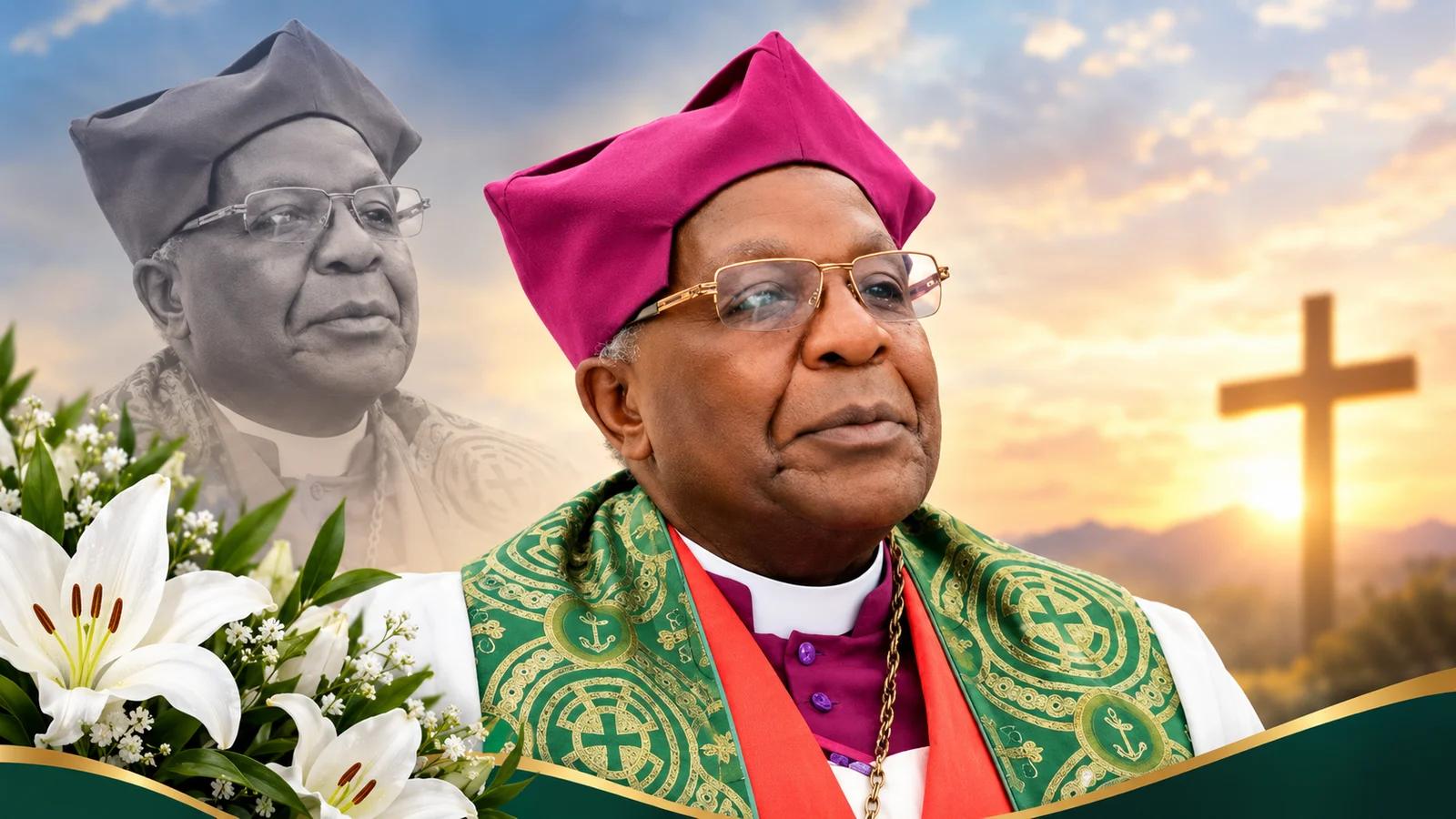
Born on January 31, 1944, in Kiteekanya, Semuto – Nakaseke District, the late Bishop Samuel Balagadde Mikisesangwa Ssekadde came into the world as the last-born son of nine children to Michael Kyobe Kiyiingi and Tolofatya Kyobe Kiyiingi, a hardworking, God-fearing couple who had married in 1928. Though modest farmers who grew coffee and maize and reared cows, they were rich in love and faith, raising their children in honesty and devotion.
Samuel often spoke fondly of his humble background. He was proud of his parents’ efforts and
the values they instilled in him—discipline, prayer, and hard work. Being their child of old age, they cherished him deeply, though money was scarce. Even so, they ensured he went to school.
His education began at Kisega Primary School, a small institution beside Kiteekanya Church of Uganda, both of which had been built by his parents to serve their community. The family worshiped in that church—a symbol of faith and unity later destroyed during the war but eventually rebuilt through their determination.
Later, Samuel transferred to Semuto Primary School, four miles away. It was there that tragedy struck—he fell gravely ill and was hospitalized at Semuto Hospital for three months, unconscious and near death. His recovery was nothing short of miraculous. He would later recount seeing a shadow move from his hospital bed—his mother said it was a priest who had come to pray for him. When he regained some strength, he uttered words that would shape the rest of his life: “If God helps me recover, I will become a priest.”
Though the doctors could not diagnose his illness, his uncle—a medical worker in Masulita—continued his treatment until he fully recovered. That long season of sickness and healing planted a divine seed in him—a call to serve God.
Having missed a full year of school, Samuel resumed his studies at Ndeije Junior School, where he completed Primary Six to Junior Two. His father bought him a bicycle, and every day he rode 24 miles to and from school. It was a tiring journey, but his determination never wavered.
He later joined Lubiri Senior Secondary Junior School, where another lesson awaited him—this time in the school of life. One day, on his way back to school, he lost all his school fees—10 shillings—to street conmen running a card game on Namirembe Road. Devastated and afraid, he walked 30 miles back home to Semuto, arriving at midnight. He confessed to his mother, who, though disappointed, borrowed money to send him back to school. That experience, he would later say, “taught me to focus on purpose rather than chasing easy gain.”
From that day, young Samuel became more industrious. Inspired by his father, he took up farming, growing cotton alongside his studies.
When he harvested and earned 800 shillings, he bought himself a motorcycle (Bantam Model)—a great achievement for a student in those days. These early experiences—poverty, illness, loss, and recovery—molded his character. They built in him resilience, faith, and a sense of purpose that later defined his journey as a teacher, priest, and bishop. He often said that his struggles were God’s way of preparing him for the ministry, where patience, endurance, and humility would become the cornerstones of his service.
Samuel’s Call to Faith and the Road to Ordained Ministry
As the story of Bishop Samuel Balagadde Mikisesangwa Ssekkadde unfolds, it becomes clear that his journey to faith and ministry was not a straight path but a divinely guided process—marked by moments of conviction, failure, grace, and restoration. It was in 1964, while he was a Senior Four student at Lubiri Senior Secondary Junior School, that Samuel first gave his life to Christ.
The Church of Uganda had introduced an evangelistic mission across schools in Kampala, and through those fellowship meetings, young Samuel encountered Jesus in a deeply personal way. He was “born again,” though at that stage, his faith was yet to mature.
After completing school, Samuel took up a job at the Entebbe Water Development Department, working as an assistant storekeeper alongside his elder brother, Aron Gwembuga Seruyigo. Later, he secured a position in the Office of the Prime Minister under Milton Obote, where he was posted to Kabale in Kigezi as an assistant to the District Commissioner.
After a year, he joined Iganga Teachers’ Training College, where he trained for two years and later began teaching at Katikamu Sebamala in 1967.
Despite his early spiritual experience, Samuel’s faith faltered during this time. He candidly admitted that he had fallen into sin, and his relationship with God grew cold. Though he continued to attend church, his heart was far from God. But grace has a way of finding those who stray. When he was transferred to Buruli Secondary School in Nakasongola in 1968, Samuel met Canon Waalwo—a man whose pastoral sensitivity and discernment would become pivotal in Samuel’s life.
Canon Waalwo noticed Samuel’s consistent church attendance and soon appointed him as a church usher. Though Samuel served faithfully, his spiritual life was still in disarray. Yet, through that service, the Canon saw potential in him and asked whether he had ever considered joining the ordained ministry. Samuel initially resisted, but the question lingered.
Could this be the fulfillment of the promise he had made as a sickly boy lying in a hospital bed years earlier—that he would serve God if given life again?
When he shared the idea with his brother Joram, the response was harsh. “Are you foolish? Do you want to die in poverty like the priests?” Joram scoffed. But his father’s response was different—he gave his blessing.
With that encouragement, Samuel went to see Bishop Dunstan Nsubuga of Namirembe Diocese, where he was tested and emerged the best performer among candidates. That opened the door for him to join Bishop Tucker Theological College (now Uganda Christian University) from 1969 to 1971.
There, Samuel excelled both academically and spiritually, graduating top of his class with a Certificate in Theological Studies. His ordination brought immense joy to his family and teachers, and his diligence soon earned him a Church Missionary Society (CMS) scholarship for further studies in Zambia.
At the Mindolo Ecumenical Foundation (MEF) in Kitwe, Zambia, Samuel undertook a course in youth and community leadership. Mindolo was a Pan-African institution known for nurturing ecumenical and visionary leaders from across the continent. It emphasized Christian unity, leadership rooted in service, and social transformation.
It was here—amid the serene, reflective environment of Mindolo—that Samuel experienced both intellectual growth and a deepening of his spiritual call. The center’s morning chapel sessions, Pan-African ideals, and cross-cultural fellowship shaped his outlook on ministry and leadership. More importantly, it was at Mindolo that Samuel met the woman who would later become his life partner, Allen—a relationship that would become another chapter in his story of faith and purpose.
Samuel’s time at Mindolo not only broadened his perspective on ministry but also rekindled his spiritual life.
Though he openly confessed to having “fallen from grace” earlier, his experience in Zambia restored his faith, reaffirmed his calling, and strengthened his resolve to serve God wholeheartedly.
MARRIAGE: GOLDEN JUBILEE & BEYOND
A Journey of Faith, Love, and Lasting Commitment
Love, as described in 1 Corinthians 13:4–8, is patient, kind, enduring, and unfailing — a divine attribute that shapes every Christian relationship. For Bishop Samuel and Maama Allen Ssekkadde, this scripture is not mere recitation but the living testimony of their union. For over fifty years, they have modeled a marriage built on faith, perseverance, and the steadfast love of God.
Their story began at Mindolo Ecumenical Foundation (MEF) in Kitwe, Zambia, in the early 1970s. Both were on training programs — Samuel pursuing Youth and Community Leadership, and Allen, then National Youth Coordinator at YWCA Uganda, attending leadership training.
What began as a simple friendship, guided by divine orchestration and gentle nudging from fellow Ugandans, blossomed into a love founded on respect, purpose, and faith.
Their marriage in October 1972 at All Saints Church, Kampala, took place during Uganda’s turbulent times under Idi Amin. Despite economic and social challenges — including scarce wedding resources — the couple celebrated a union centered not on glamour, but on God’s providence. Through patience and faith, they overcame every trial, proving that true love is not about ease but endurance.
Over the decades, Samuel and Allen have raised six biological children — and many more spiritual ones — teaching them Christian values through love, example, and prayer. Family visits to schools, shared meals, and conversations grounded in faith kept the family united. Their children grew up witnessing hard work, humility, and the sacred bond between ministry and home.
Their marital journey was not without trials, but Allen’s strength and Samuel’s faith complemented each other. “My wife is a genius,” Bishop recalls, “Her strength and consistency were my great support in serving God.” Together, they built a peaceful home in Bugonga, Entebbe, a sanctuary that echoes their faith — serene, humble, and filled with gratitude.
The couple attributes their lasting marriage to patient love — love that waits, forgives, and endures. “For better or worse,” they say, “we chose to remain faithful.” They emphasize that this kind of love, which mirrors God’s faithfulness, is the foundation of a lasting union.
Today, as they celebrate over 50 years of marriage, Bishop and Maama Allen remain passionate about strengthening Christian families. They mentor couples, clergy families, and young believers to view marriage not as a social contract, but as a divine covenant sustained by God’s grace.
Reflecting on today’s challenges, they lament the weakening foundations of modern relationships.
“Many young people,” they observe, “fear commitment because they were never nurtured in godly character.” Their advice is clear — marriage thrives when both partners are grounded in faith, humility, and prayer. For Maama Allen, her personal journey from a devout upbringing under her grandmother, Jajja Mulongo Babirye, to becoming a committed follower of Christ, reshaped her role as a wife and minister. “Giving my life to Christ opened my eyes to the calling of God on my husband’s life,” she recalls. Her transformation empowered her to serve alongside her husband, guiding other clergy wives and ministering to women across Uganda. Their story — from youthful love in Zambia to five decades of marriage rooted in Christ — stands as a living testimony that divine love truly never fails.
“Marriage,” says Bishop Ssekkadde, “is not about perfection but perseverance. When love is anchored in Christ, it endures every storm and shines even brighter through the years.”
Bishop Samuel Balagadde Ssekkadde & Maama Allen: A Divine Partnership in Service
A Calling to Serve God
Every divine journey begins with a call — one that interrupts ordinary life and redirects it toward eternal purpose. For Rev. Samuel Balagadde Ssekkadde, that call came while already in priestly ministry, though his heart had yet to truly encounter the transforming power of Christ. His early years in service were marked by struggle and spiritual dryness — until one day, during a Bible study at Ndwaddemutwe Parish in 1974, the Lord spoke to him through Ephesians 5:14:
Awake thou that sleepest, and arise from the dead, and Christ shall give thee light.”
That moment revived his faith and reshaped his ministry. His preaching gained divine power, his parish experienced revival, and the once spiritually dark community turned to Christ. He often referred to himself as “a saved sinner in service to God.”
Despite the poverty and hardship, Rev. Samuel and his wife Maama Allen served with humility and joy. Living in a mud house, sleeping on flea-infested floors, and often going without money, they nevertheless radiated gratitude and faith. Their eight months in Ndwaddemutwe produced a legacy still spoken of today — a testimony of selfless service and revival.
Maama Allen: Priest to the Priest
Behind every great servant of God is often a steadfast partner. For Maama Allen, the Lord impressed upon her heart a unique calling — to minister to clergy wives through the Church of Uganda Women’s Ministry.
“We may not be as theologically trained as our husbands,” she taught, “but God has called us to be priests to our priests.”
Her ministry empowered clergy wives to understand their divine role as supporters, encouragers, and prayer partners to their husbands. Later, as a Bishop’s wife, she used every platform — from the Church to the YWCA, where she worked — to train, mentor, and uplift women. She often emphasized two vital virtues in life: the fear of the Lord and the sense of humanity.
Growth in Ministry and Leadership
After Ndwaddemutwe, Rev. Samuel joined Bishop Tucker Theological College for a Diploma in Theology, later serving as a student tutor — a testament to his brilliance and dedication. His journey then led him to Namugongo Martyrs Seminary, where he served as Principal and Parish Priest. At Namugongo, Rev. Samuel’s ministry flourished. He trained hundreds of young ministers across six dioceses — shaping them not only academically but spiritually and morally. His discipline, humility, and godly conduct became a benchmark for ministerial excellence.
His approach to pastoral theology challenged students to examine their true calling:
“Do not study for a job; study for the call of God.”
Through his leadership, countless students dedicated their lives to Christ and went on to serve as leaders in the Church of Uganda.
Kyebando and Kalitunsi: Expanding God’s Work
While pursuing his Bachelor’s in Social Work and Social Administration at Makerere University, Rev. Samuel also served at St. Paul’s Church, Kyebando, where he founded the Christian Women Fellowship (CWF) and laid the foundation for Kyebando’s growth into a Parish.
His evangelistic zeal birthed St. Peter’s Church Kalitunsi in the early 1980s. Moved by compassion for men lost in drunkenness, he began open-air services under eucalyptus trees — the humble beginnings of a now-thriving congregation. His ministry to the marginalized demonstrated his conviction that “the gospel is for all people — from housemaids to millionaires.”
Scholarship, Sacrifice and Service
In 1982, Rev. Samuel trained in Bible Translation at the Kenya United Bible Society Centre, contributing to the Luganda Ecumenical Bible, which included the Apocrypha. His translation work bridged denominations and deepened Uganda’s Christian heritage. In 1984, tragedy struck when his successor at Namugongo was brutally murdered by soldiers. Despite the danger, Rev. Samuel accepted the Bishop’s call to return as Principal, serving courageously amid national unrest. His decision, he said, was not about bravery,
“but grace — for my will was no longer my own.”
His wife Allen shared equally in the risks and sacrifices, surviving an armed robbery alone in their home but choosing faith over fear.
The Scholar-Bishop
In 1987, Samuel received a British Council Scholarship to study for a Master’s Degree in Development Administration at the University of Birmingham (UK). His excellence earned him a place in the PhD program, but before completion, Bishop Misaeri Kauma recalled him to serve as Namirembe Diocesan Secretary (1988–1994). Obedient to the divine call, he returned — later elected and consecrated Bishop of Namirembe Diocese on December 4, 1994.
Legacy of Faith and Service
Bishop Samuel and Maama Allen’s lives are a symphony of obedience, humility, and steadfast faith. From mud houses to global platforms, from hardship to honor, their story reminds the Church that ministry is not a position but a life laid down for God. Their partnership — spiritual, intellectual, and emotional — stands as a model of servant leadership rooted in love, perseverance, and divine calling.
“We served with joy,” says Maama Allen, “because the God who calls is faithful.”
MISSION AS BISHOP (1994–2009) A Shepherd at Namirembe
“If a man desire the office of a bishop, he desires a good work.” — 1 Timothy 3:1
The morning of December 4th, 1994, dawned with an air of holy expectation. The sun rose over the hills of Kampala to find roads winding toward St. Paul’s Cathedral Namirembe alive with song, colour, and celebration.
From every corner of Uganda and beyond, clergy, lay people, and dignitaries came to witness a sacred moment — the consecration and enthronement of The Rt. Rev. Samuel Balagadde Ssekkadde, the newly elected Bishop of Namirembe Diocese. It was more than a ceremony; it was the fulfilment of a divine calling.
The Making of a Bishop
In the Anglican tradition, the office of bishop is not sought but bestowed. It is not a crown of prestige, but a yoke of service. When the time came to choose a new shepherd for Namirembe Diocese, the nomination committee — fifteen individuals led by the Chancellor — prayerfully presented two names to the House of Bishops. After careful deliberation and with more than a two-thirds vote, the lot fell upon Rev. Canon Samuel Balagadde Ssekkadde, then Diocesan Secretary of Namirembe.
The announcement was met with joy and thanksgiving. To many in the Anglican community, his election felt both inevitable and inspired — a man of learning, humility, and seasoned faith now called to lead the mother diocese of the Church of Uganda.
The Consecration at Namirembe Cathedral
That December morning, Namirembe Hill became a sea of humanity. The cathedral, Uganda’s oldest and most storied, stood adorned in its full Anglican dignity. The pews overflowed with believers, political leaders, and visitors from across the provinces and from beyond Uganda’s borders. Choirs sang hymns of consecration as clouds of incense rose heavenward, mingling with tears of joy.
The Archbishop Yona Okoth presided, assisted by a host of bishops robed in splendour. The service began with the reading of 1 Timothy 3:1–6, a solemn reminder of the sacred weight of the episcopal calling:
“A bishop must be blameless, the husband of one wife, vigilant, sober, of good behaviour, given to hospitality, apt to teach…”
After the Gospel and Nicene Creed, the Bishop-elect — vested simply in his Rochet — was led before the Archbishop by two bishops who declared: “Most reverend Father in God, we present unto you this godly and well-learned man to be ordained and consecrated Bishop.”
Then followed the examination — questions that tested not merely intellect but conviction, commitment, and courage.
Rev. Ssekkadde responded with humble assurance:
· Yes, he was persuaded of God’s call.
· Yes, he would teach nothing but the truth of Scripture.
· Yes, he would defend sound doctrine.
· Yes, he would live soberly, righteously, and godly.
· Yes, he would show mercy to the poor, and seek peace among all people.
The Archbishop then prayed:
“Almighty God, our heavenly Father, who hath given you a good will to do all these things; grant also unto you strength and power to perform the same…”
Moments later, the hymn “Veni, Creator Spiritus” filled the cathedral as the bishops gathered around the kneeling priest. The Archbishop laid hands upon his head and said:
“Receive the Holy Ghost for the office and work of a Bishop in the Church of God, now committed unto thee… In the Name of the Father, and of the Son, and of the Holy Ghost.”
It was exactly noon when Samuel Balagadde Ssekkadde rose — no longer Rev. Canon, but Bishop of Namirembe.
The Bible was placed in his hands as the symbol of divine authority, followed by the pastoral staff and bishopric ring — instruments of shepherding, guidance, and covenant. The cathedral erupted in applause, ululations, and song. And when he finally took his seat — the Cathedra, the Bishop’s chair — the third African shepherd of Namirembe had been enthroned.
A Historic See
To be Bishop of Namirembe is to inherit both legacy and responsibility. The cathedral’s stones are soaked in the prayers, tears, and triumphs of Uganda’s faith journey. From its altar, bishops since 1882 have guided the nation’s first diocese — from James Hannington, the martyr-bishop, to Henry Parker, Alfred Tucker, and Leslie Brown, and later African successors Dunstan Nsubuga and Misaeri Kauma.
Now, history had turned another page. Bishop Ssekkadde became the ninth bishop in the line of succession, and only the third African to sit on that throne.
The Weight of Leadership
The bishopric of Namirembe is not a ceremonial seat; it is the heartbeat of Anglicanism in Uganda. With it came automatic responsibilities — Chairmanship of the Boards of historic institutions such as King’s College Budo, Gayaza High School, and Mengo Secondary School. Bishop Ssekkadde approached each role with a scholar’s mind, a father’s heart, and a servant’s hands. His episcopacy was marked by pastoral discipline, spiritual renewal, and administrative integrity. He was a teacher-bishop — vigilant, sober, apt to teach — true to the words of Scripture read on his consecration day.
A Shepherd’s Legacy
For fifteen years — from 1994 to 2009 — Bishop Ssekkadde shepherded Namirembe Diocese with humility and steadfastness. He led through times of peace and turbulence, guiding clergy and laity alike toward unity and spiritual growth. His episcopal mission was not to magnify his name, but to magnify Christ. Those who served with him remember his calm authority, his devotion to Scripture, and his unwavering sense of duty. To him, the office of Bishop was never a throne of comfort, but a cross of service.
He often reminded his clergy:
“We are not called to be famous — we are called to be faithful.” And faithful he remained, until his last day in office.
An Enduring Testament
Looking back, the consecration of 1994 was more than the rise of a man; it was the affirmation of God’s faithfulness to His Church. Namirembe’s bells, which have tolled for kings, presidents, and martyrs, rang that day for a humble servant — one who would leave the diocese stronger, steadier, and more spiritually rooted than he found it.
“Receive the Holy Ghost for the office and work of a Bishop…”
Those words still echo through Namirembe’s arches, long after Bishop Ssekkadde’s voice has fallen silent — a timeless reminder of the man who answered the call and served with grace.
About the author
Isaiah Philemon Ssengonzi
Isaiah is an author and an inspiring team member at The Complete Clergyman, contributing his creativity, passion and commitment to the ministry’s mission.
Continue reading
All articles →
article
Rev. Canon Eridad Milton Shissa Elected 9th Bishop of Mbale Diocese
Mbale Diocese set to receive new Bishop
article
What is a Priest called to do?
“Be shepherds of God’s flock that is under your care, watching over them.” 1 Peter 5:2, NIV